
AI won't find your next player. That might sound strange coming from a football tech founder, but the more time I spend with sporting directors, executives and recruitment teams, the more I think we talk about AI in recruitment the wrong way.
Yes, AI can give you a list of players. That part is becoming relatively easy.
The harder question is whether your club actually knows what it is looking for. What does the role require in your game model? What is missing from the squad? Does the player need to perform immediately, or develop over time? How much financial risk can you take, and where are you willing to compromise?
Those are football questions before they are technology questions. If you have not answered them properly, even a very good model will mostly give you another list of names.
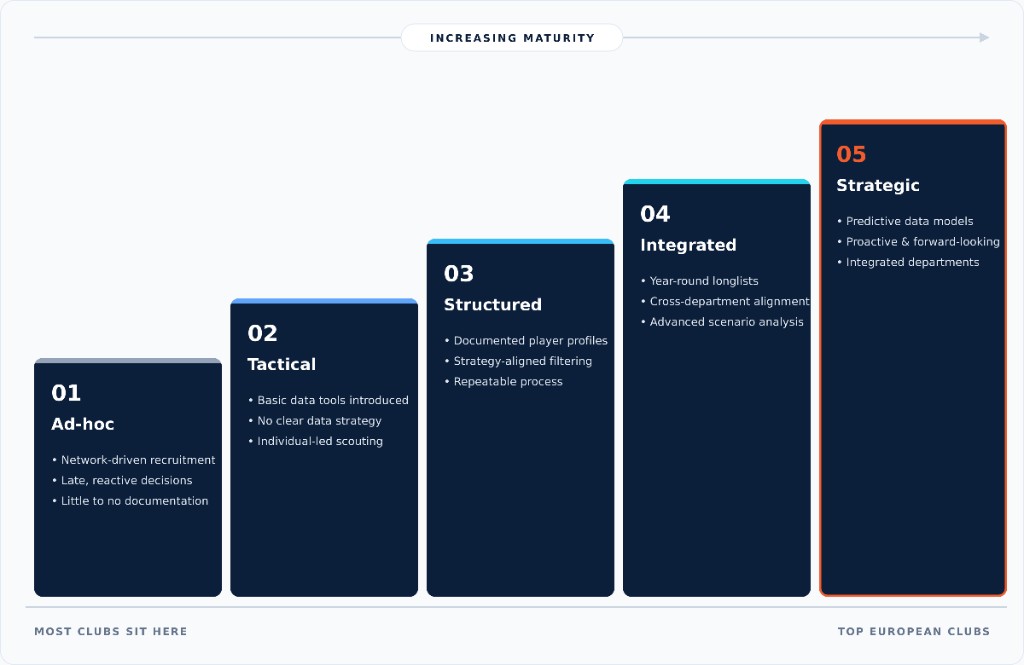
Some of the strongest recruitment environments we work with, including Bodø/Glimt, Viking and Tromsø, tend to start with that work first. They define roles, discuss future squad needs, align internally and build pipelines before the need becomes urgent.
Once that foundation is in place, technology becomes much more useful.
AI gives recruitment teams more capacity
I think one of the biggest opportunities with AI in recruitment is actually quite practical: capacity.
A recruitment team simply cannot watch every relevant match in every relevant league every single week. Even a very good scouting department has physical limitations. There are only so many hours in the day, and the reality for most clubs is that the recruitment team is also dealing with agents, contracts, coaches, board requests, outgoing players, incoming players and whatever else happens to appear that morning.
A model does not have the same limitation. It can continuously analyse thousands of players and millions of actions across the market, and if the club has done the work of defining what it values in a certain role, technology can keep comparing players against that profile every week.
That, for me, is where it starts becoming genuinely useful.
The goal should not be to tell a sporting director, "This is the player you should sign." It should be much closer to: "Based on what you have told us you are looking for, these are the players you should probably spend your time looking at, and this is why."
The second part is incredibly important.
If a player ranks highly, the people making the decision should be able to understand what is actually driving that result. Which actions does he perform well? Which parts of the role does he fit? Where does he look different from the players you already have? And just as importantly, where does he not fit?
I would be very uncomfortable building technology that asks good football people to blindly trust a score produced by a model. AI should help people understand more of the market, not turn recruitment into a black box.
For smaller clubs, this becomes even more interesting. A recruitment department of three people will never manually cover the same amount of football as a department of thirty. Technology will not remove that difference completely, but it can help close the gap and allow a small team to monitor a much larger market than they otherwise could.
Good software still matters more than AI
The second opportunity is actually less about AI itself. For me, the most important thing is still good software and a well-structured workflow. If information sits in five different places and people are constantly moving things around manually, adding AI on top will not suddenly fix the process.
Once the software and structure are in place, though, AI becomes very useful. It can summarise reports from different scouts and help you quickly understand the common observations, or read information from documents and messages that someone would otherwise have to upload and type in manually.
These are simple examples, but they save time. Good software should organise the recruitment process, and AI can help remove some of the repetitive work inside it.
That means scouts spend less time typing and organising information, and more time actually watching football.
For me, that is where AI in recruitment is most interesting. Not as something that takes over the process, but as something that gives good football people more time and better tools to do their job.
"AI won't find your next player. Your recruitment process will."