
Every summer transfer window, we hear the same questions over and over again:
Which players should we sign?
But increasingly, the more strategic clubs ask a more important question:
Are we actually set up to reach the level of ambition we have as a club?
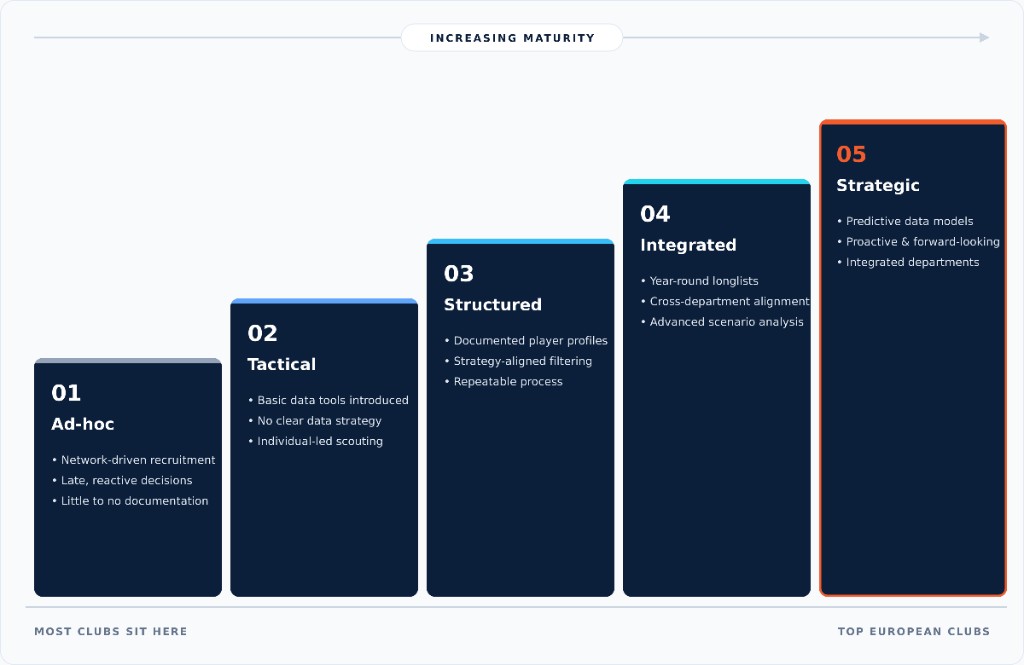
Earlier this year, we wrote about The Recruitment Ladder - our framework describing the five levels of recruitment maturity we typically see across professional football clubs. Many clubs immediately recognize themselves in this framework, not only in terms of scouting or data usage, but in how their football operations work structurally.
That is exactly what more clubs seem to be revisiting this summer.
Because after years of working with sporting directors, scouts and analysts across European football, one thing has become very clear to us:
Most recruitment challenges are no longer about finding information.
They are about creating a better recruitment process.
The challenge is no longer access to data
Today, more clubs than ever have access to football data, video, reports and internal expertise.
- Data providers
- Video and analysis
- Reports and evaluations
- Internal football expertise
The problem is rarely the lack of information - it is that recruitment workflows are often fragmented. During a transfer window, this becomes very visible:
- Scouting information lives in different places
- Departments work in silos with different contexts
- Recruitment becomes reactive instead of proactive
The clubs improving fastest are usually not the ones focused around maximizing the collection of information. It is the ones building the clearest recruitment process to put the information into the right, aligned context.
Over time, we have noticed that clubs usually revisit recruitment from three different starting points:
Emerging clubs
Trying to compete with larger recruitment departments on a limited budget.
Established clubs
Trying to create more value from the work they already do.
Enterprise clubs
Trying to scale recruitment operations across the organization.
1. The Emerging Club
"How do we compete with clubs that have bigger recruitment departments?"
These clubs are often ambitious and growing quickly. Results improve, expectations increase and recruitment activity becomes more important, but internally, only a small number of people are often responsible for scouting, analysis and squad planning.
At the same time, recruitment is becoming a much more important part of the football club itself.
More clubs want ownership of recruitment internally instead of relying heavily on agents, networks or external recommendations. Recruitment is increasingly seen as a core competitive advantage.
Which means smaller clubs need to work smarter.
Many recruitment teams spend too much time:
- Organizing spreadsheets
- Moving information between tools
- Searching manually for players
Instead of spending time where they create the most value:
- Watching players
- Discussing profiles
- Making football decisions
This is where better recruitment infrastructure becomes a differentiator - not by replacing people, but by giving heads of recruitment and sporting directors better tools to work more efficiently and aligned.
At Fokus, clubs work directly with infrastructure focused entirely on football recruitment, scouting workflows and player identification, customized to your club and way of working. The goal is not to replace football expertise.
It is to help smaller recruitment teams work with the same level of structure, speed and clarity typically seen in much larger organizations.
The clubs improving the fastest are usually the ones that:
- Narrow markets faster
- Identify relevant profiles earlier
- Centralize scouting and evaluations
- Build continuity between windows
At this stage, clubs are usually not trying to copy elite recruitment departments - they are trying to create more leverage for the people already inside the club. Bodø/Glimt is one of the strongest Scandinavian examples of how aligned recruitment processes and operational clarity can help a club outperform larger organizations over time.

“With Fokus, we are now better informed when making a signing.”
Håvard Sakariassen · Sporting Director, FK Bodø/Glimt
Læs mere2. The Established Club
"How do we create more value from what we already have?"
These clubs already have scouts, analysts, recruitment leadership and multiple data sources. In many cases, these clubs have already invested heavily into:
- Data analysts
- Recruitment processes
- Data tools
But despite all of that, the full picture still often feels unclear. Why? Because information is spread across different workflows. Scouts work in one process. Analysts work in another. Squad planning happens elsewhere. Leadership discussions happen separately. The club has the information, but it does not always have alignment.
At this stage, the question is no longer "How do we get more data?"; it is "How do we create more value from the work we already do?"
The strongest improvements usually come when clubs connect:
- Scouting and analysis
- Player evaluations and squad planning
- Departments into one shared workflow
The goal is not necessarily more information; it is a clearer and more connected picture. Rosenborg BK is a strong example of a club working to connect scouting, coaching, leadership and recruitment into one shared process.
“Fokus has allowed us to bring scouting, coaching, leadership and finance into the same workflow. It has made us more robust and more aligned as an organisation.”
Per Jarle Dalum · Technical Director, Rosenborg BK
Læs mere3. The Enterprise Club
"How do we scale recruitment operations across the organization?"
At the highest level, recruitment becomes a broader operational challenge. These clubs manage recruitment across multiple markets, large scouting departments and increasingly complex football operations. The challenge is no longer finding information - it is scaling decision-making across the organization. At this stage, the focus shifts toward:
- Shared recruitment infrastructure
- Connected workflows across departments
- Reducing friction between teams
They are the ones building environments where aligned recruitment decisions happen consistently over time. AGF is a strong example of a club working with connected workflows across scouting, analysis, academy and leadership.
“Fokus has brought our scouts, analysts and academy closer together in one shared workflow.”
Carsten Jensen · Director of Football, AGF
Læs mereVores perspektiv på ændringen i rekrutteringsstrategien
Recruitment is becoming less about collecting information and more about creating better workflows around recruitment decisions.
The clubs improving fastest are usually the ones creating:
- Clearer processes
- Stronger alignment
- Better continuity
Clubs experience this differently depending on maturity level, but the underlying challenge is often the same: How do we consistently make better recruitment decisions as an organization? That is the question more clubs seem to be asking this summer.
For at holde sig foran på markedet skal klubber investere i de bedste værktøjer. Fokus har hjulpet 50+ klubber med at arbejde smartere med rekruttering, med professionelle data scientists, der guider jer i arbejdet med rekruttering.
Vil I vide mere? Kontakt os.
Fokus har hjulpet 50+ klubber med at arbejde smartere med rekruttering. Hvis jeres klub genovervejer sin rekrutteringsopsætning i sommer, så kontakt os for at tale om, hvordan vi kan hjælpe.

Kristian Schnell
kristian.schnell@fokus.ing