A sporting director is responsible for building the right squad, season by season, and for making sure that the decisions taken in one transfer window still make sense two or three windows later.
One sporting director put it to me like this.
"Building a football squad is like assembling a plane while it's already in the air."
The plane has to keep flying while you replace the parts, and the turnover is both large and complicated. Players are sold or get injured, contracts run out, and young players need minutes at exactly the moment the first team can least afford to give them away.
Over time, the clubs that manage this well tend to have one thing in common, which is a consistent approach to recruitment that does not change direction every time the results do. Bodø/Glimt and Viking are two good examples from recent years, and in both cases the consistency shows in who they sign and in how they think about the squad as a whole.
Consistency, however, starts with overview, and the screenshot below shows a demo squad in Fokus as of 26 October 2026, with the age and contract expiry year for every player in the starting eleven and their closest backup.
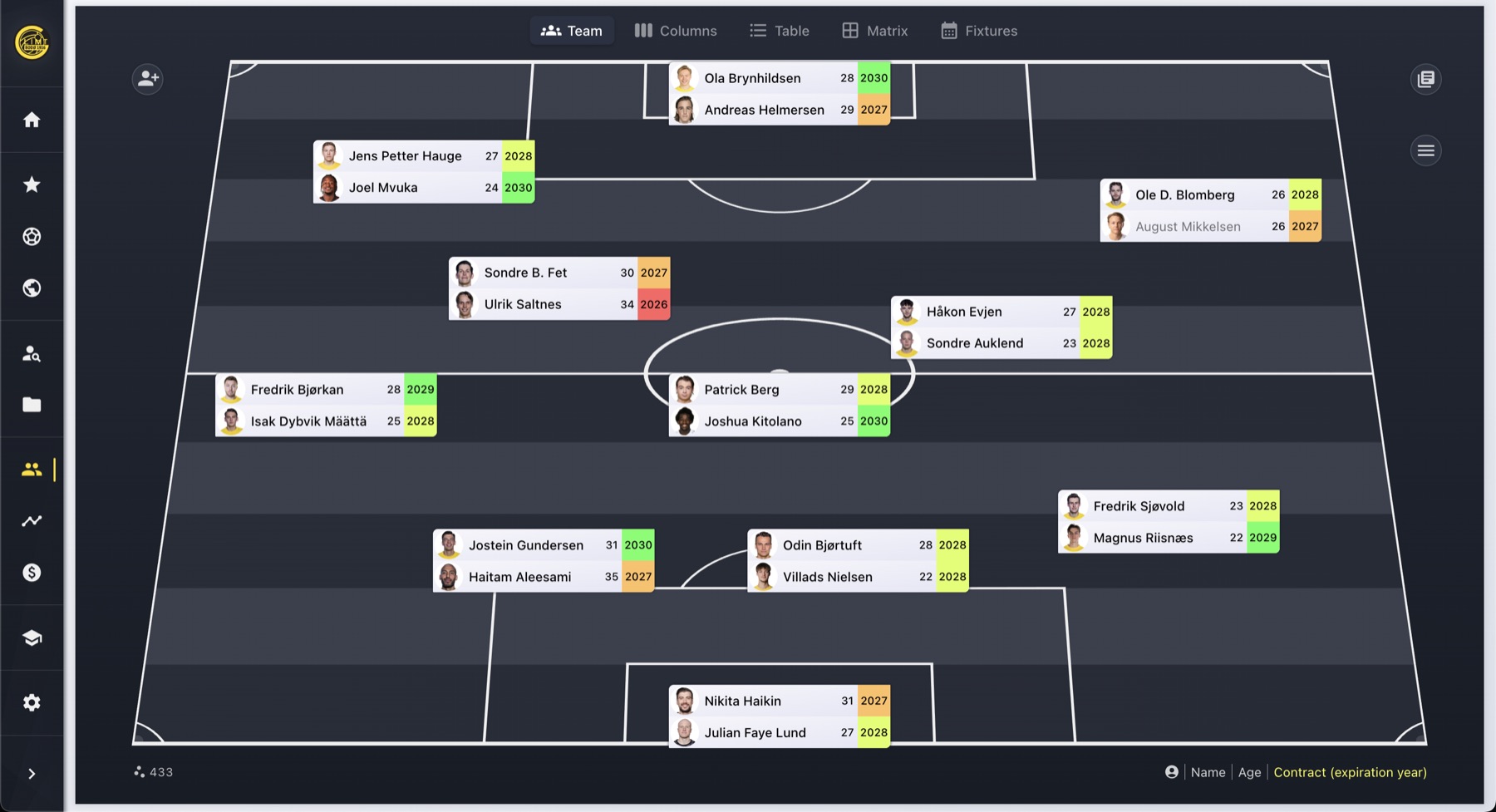
LCM (left central midfield) stands out as a position that needs planning. Sondre Fet is 30 and under contract until 2027, while Ulrik Saltnes is 34 and has a contract that runs out in 2026, so the club has to decide whether to extend one or both of them, or whether this is the moment to start renewing the position with a younger player who can take over within the next year or two.
That is a single position, and it is already a difficult conversation, because a squad has eleven of them. Every decision in one position affects the others, and the answer depends on performance, money, age profile and the club's ambitions all at once. To make that conversation easier across the whole squad, we built Health score.
The five KPIs
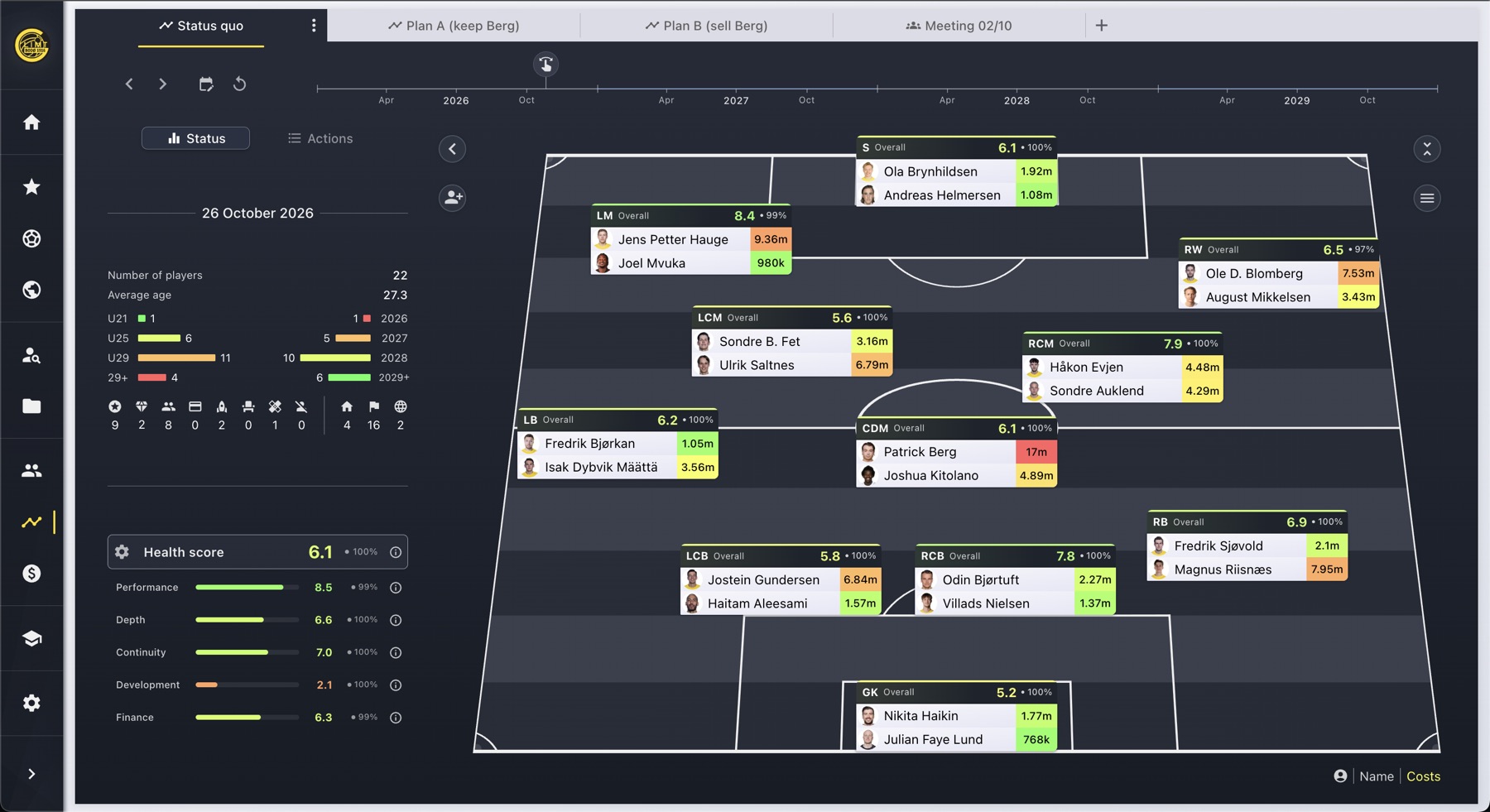
Health score evaluates every position in the squad on five KPIs, each scored from 0 to 10, and combines them into an overall score for the position and for the squad as a whole.
- Performance. The quality of the players expected to carry the position, weighted by how much each of them is expected to play. Quality is represented through the Fokus skill index, measuring the underlying quality of each player's contributions to the expected goal difference, combined with opponent team strength for a global scale.
- Depth. Whether there is enough cover if the main option is out. It also includes players who can play more than one position.
- Continuity. Whether the position stays covered as contracts expire.
- Development. Whether young players are getting meaningful first-team minutes.
- Finance. How well player costs line up with expected involvement and performance.
Back to LCM
Hover over LCM in the squad planner and the position scores 5.5 overall, and more importantly the card explains why.
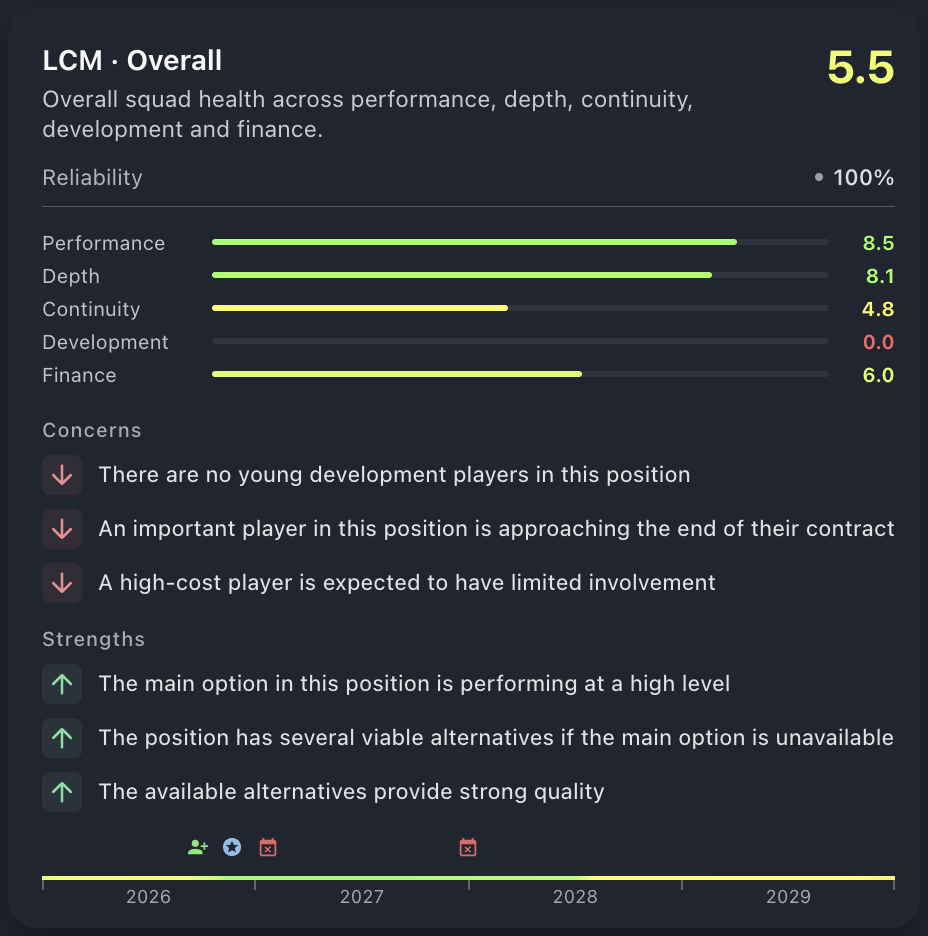
On the surface the position looks fine, because the main option is performing at a high level, which gives a Performance score of 8.5, and with two viable alternatives of strong quality, Depth is 8.1, while the problems sit underneath. Continuity is down at 4.8 because an important player is approaching the end of his contract, Finance is 6.0 because a high-cost player is expected to have limited involvement, and Development is 0.0 because there are no young players in the position at all. Each card also shows a reliability figure, so you know how much data the score rests on.
Whether that 0.0 is a problem depends on the club's strategy. For Bodø/Glimt today the objective is simple, which is to win the league and qualify for Europe, and development is not the priority for that. Picture the same club when it was playing in the second division, and the priorities would be the opposite, so a 0.0 in Development would be a clear warning. We wrote about that journey in Bodø/Glimt: From Norwegian second division to the Champions League. The score tells you where you stand, but your strategy decides which of the numbers matter most.
Add a target, and the score follows
Say the club decides to act and adds a target, Silas Andersen, 24 years old, on a contract running to 2030. The moment he goes into the plan, Health score recalculates the position.
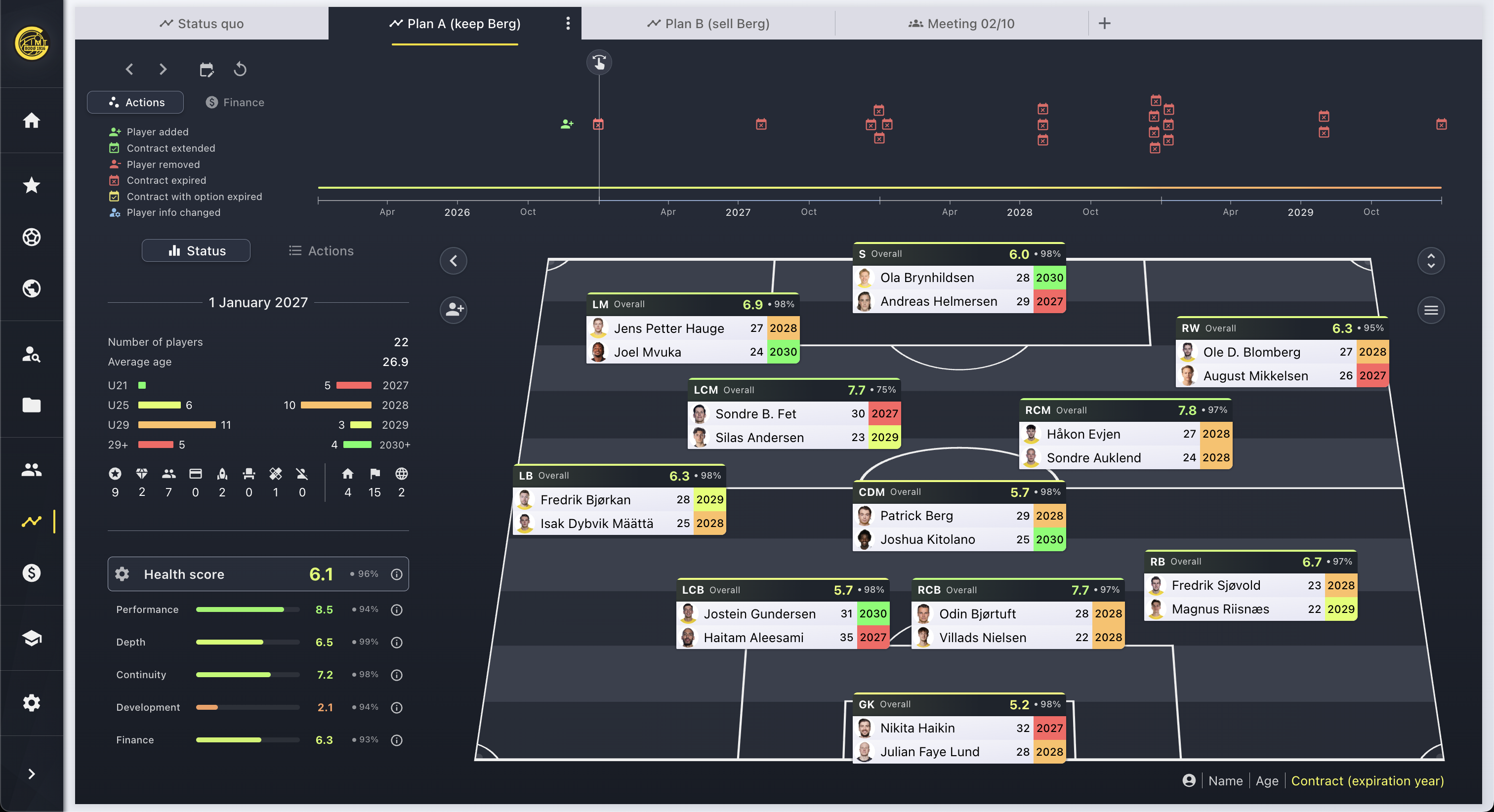
LCM rises from 5.5 to 7.7, because a young player is now expected to get meaningful minutes and perform well, but the position card still flags the expiring contract and the high-cost player, so signing Andersen answers one question and immediately raises the next one, which is what the club should do with Saltnes.
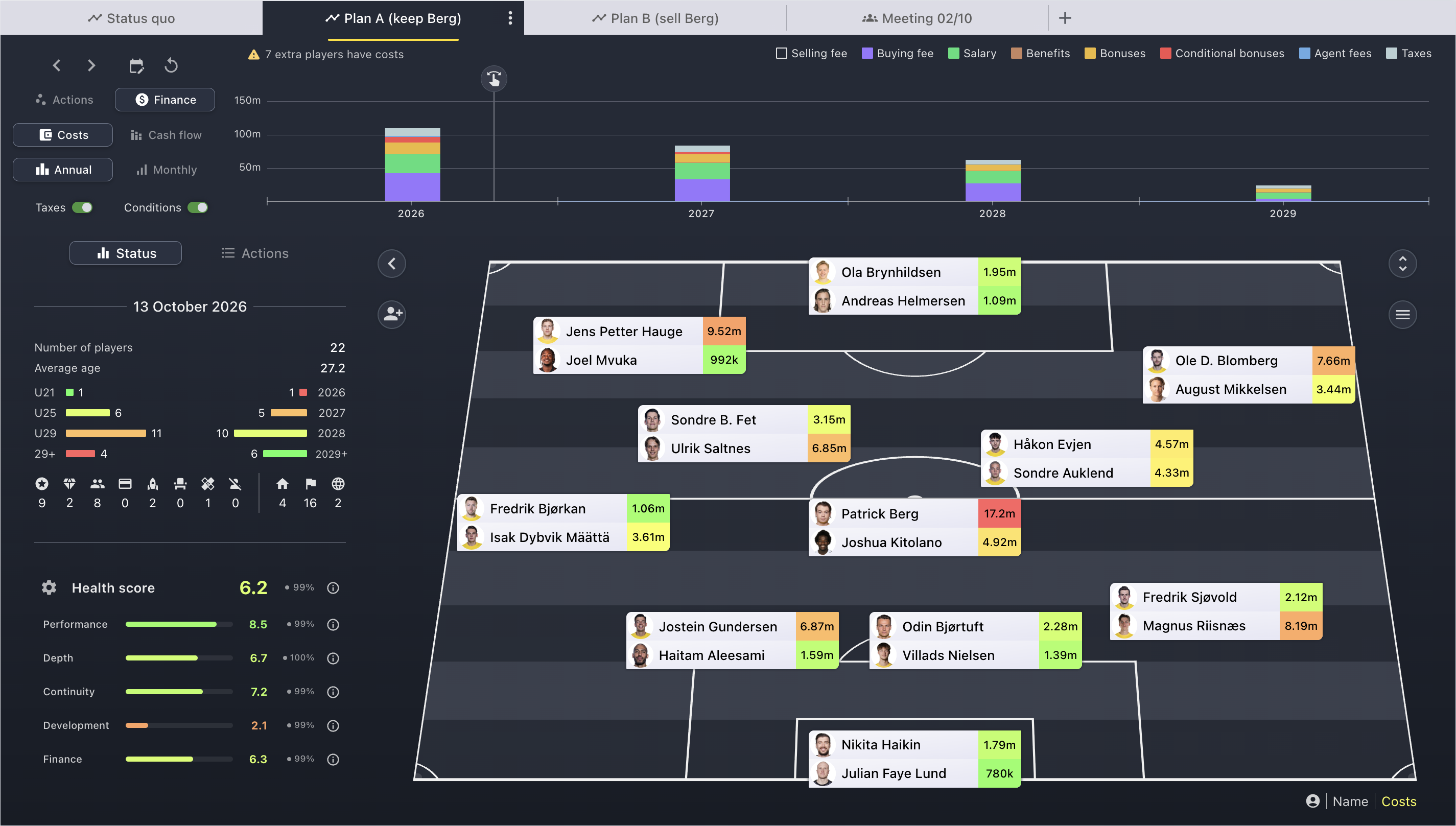
The same logic applies to bigger decisions. In the demo, the club has Status quo, Plan A to keep Berg and Plan B to sell Berg open side by side, each with its own Health score, so the trade-off between freeing up money and weakening central midfield can be compared position by position and year by year.
Put recruitment at the top of the agenda in the board meeting, with all the information in one place
Most clubs don't have a strategy problem, they have an execution problem. The strategy is usually written down somewhere, but what is missing is a reliable way to apply it window after window, especially when the pressure rises and the people in the room change.
Health score is how a club can keep one language for those decisions, so that every target is measured against the same five KPIs and you can see how a young signing changes the squad before you make the offer. When people move on, the reasoning behind the decisions stays with the club.
We believe recruitment decisions belong at the top of the agenda in every board meeting, which is why all Fokus clients now have access to Health score for their squad. Building the plane in mid-air will never be easy. But together with cost management and cash flow analysis, team strength, and custom player rankings, you at least get a cockpit with working instruments, and every stakeholder on board.
All figures and screenshots are demo data. Scores and costs are fictional.