
From the most advanced recruitment departments in Europe to clubs lower down the Norwegian professional pyramid, one thing is clear: the level of professionalism in recruitment varies dramatically across borders and league levels.
Traditional scouting will always remain essential, but data is no longer optional. It is becoming a fundamental layer for structure, consistency, and decision-making in transfers - and the clubs that embrace this shift are the ones shaping the future of football.
Synthesizing qualitative input from 100+ meetings with sporting directors and other key stakeholders across leagues and levels, we have developed a framework that divides modern football clubs into five buckets.
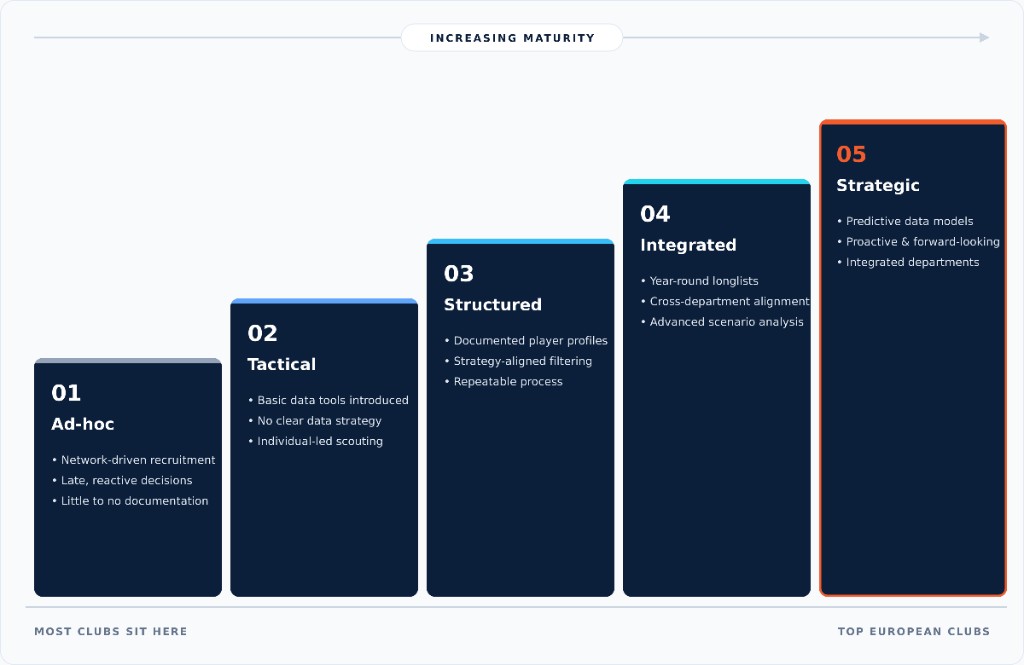
The recruitment ladder, explained
- Recruitment is driven by personal networks
- Decisions are made late, with little to no long-term planning
- There is minimal documentation or evaluation after decisions are made
- Basic tools are introduced to make recruitment more data-driven
- Investment in data does not follow a clear strategy for how it contributes to club goals
- Scouting is still driven by individuals rather than a coordinated process
- Clear documentation of player profiles and recruitment criteria
- Data-driven filtering of players in line with the club's strategic plan
- Recruitment is treated as an organised, repeatable process
- Advanced data and scenario analysis are used to contextualise decisions
- Recruitment is embedded across departments with strong alignment
- Longlists are maintained year-round, supported by advanced data
- Recruitment is forward-looking, proactive, and predictive
- Predictive data models are used to de-risk decisions and maximise ROI
- Strategic, financial and performance departments are fully integrated
Why the ladder matters
Money talks. In modern football, a profitable transfer business is a key indicator of success - yet many clubs still lack a holistic recruitment plan. Most realise data is essential but struggle to extract its full value because of limited expertise and fragmented systems. As a result, more and more clubs are looking to integrate their entire squad-management workflow into one platform, rather than relying on isolated parts of the process and being “lucky”.
How clubs climb the ladder
Lower-tier Norwegian clubs and top Bundesliga clubs sit at very different points on the ladder, but every club has the opportunity to steer its long-term recruitment operation toward a more professional level. For a top Bundesliga club, levelling up might mean buying additional, expensive datasets to add marginal context to each decision. For the majority of professional clubs, levelling up is not about spending more money on data - it is about connecting the dots and getting more out of existing resources.
From - Tactical
02- Time spent reconciling tools and reports
- Recruitment driven by individual scouts
- Data exists, but isn't tied to strategy
To - Structured
03- Documented profiles & criteria
- Filtering aligned to club strategy
- More time on watching and evaluating players
A typical “from-to” state for a club climbing from Tactical to Structured.
Access to contextual event data is, of course, a prerequisite for climbing the ladder. But once that first step is taken, most of the value comes from fitting the data into a useful structure and foundation aligned to each club's ambition and strategy. This is where a clear gap in understanding still exists for many clubs.
As an example: imagine a club spending too much of its already-scarce resources interpreting and aligning multiple dashboards, trying to extract value from overly complex datasets. Clubs with this mentality are often stuck on the Tactical level. Now imagine using data to remove friction from the recruitment process - replacing fragmented workflows with structured, aligned, documented decision-making. The result: less time managing information, more time watching and evaluating the right players. That is a club clearly moving toward the Structured level.
Key takeaway
To succeed as a modern football club over the long run, relying on luck in the transfer window is not a strategy. The clubs that succeed are not necessarily those with the most data - they are the ones that know how to turn data into aligned decisions. That is the gap we at Fokus are working to close.
"Smart recruitment starts with structure. When the structure is right, data becomes essential."
 Håvard Sakariassen · Sporting Director, FK Bodø/Glimt